great soulless corporation.”
 Though far less lucrative, the 1858 “Almanac Trial” remains one of Lincoln’s best-known cases. The legend goes that upon hearing a witness claim that he saw a murder committed by moonlight, Lincoln produced an almanac showing that the moon wasn’t up at the time. The defendant, “Duff” Armstrong, an acquaintance of Lincoln’s from New Salem, was acquitted. But the case may not have been as open-andshut as that. Lincoln simply discovered that “moonset,” when the moon falls below the horizon, occurred about an hour after the murder, casting doubt on the witness’ assertion that the moon was directly overhead. Yet, as historian John Walsh has noted, the moon’s position in the sky also depends on the observer’s point of reference — and the moon was, in fact, visible enough to see by. Walsh attributes the famous acquittal less to scientific fact than to the manner in which Lincoln delivered the “evidence,” as well as his closing arguments to the jury. Just what you pay an attorney for — effective representation.
Lincoln-Herndon Law Offices, Sixth and Adams, 217-785-7289, www.oldstatecapitol.org. Open 9 a.m.-5 p.m. Tuesday-Saturday. Free admission. Donations accepted.
The Lincoln Tomb
Within hours of Lincoln’s death, the Springfield City Council passed a special resolution seeking to secure the return of the city’s favorite son. During the Washington, D.C., funeral, about 400 people from Illinois attended a special meeting in the White House’s East Room to lobby for the body. Through Robert Todd Lincoln, state politicians convinced Mary Todd Lincoln that her late husband belonged in Springfield. Mary initially resisted. Her first choice was Chicago, followed by Washington. Eventually she relented and only then was she told that a Springfield committee had already purchased land downtown on which to construct a monument. She put her foot down and the president was buried at a quieter resting place in Oak Ridge Cemetery.
Oak Ridge is the largest cemetery in Illinois and the second most visited in the nation (after Arlington National in Washington, D.C.). The striking tomb containing Lincoln and his family (except for Robert, who is buried in Arlington) was designed by Larkin Mead and completed nine years after Lincoln’s death. It has been restored several times since. Tours are available, and special events are held throughout the year.
Enter the cemetery by going north on Monument Avenue, which lies off North Grand between First and Second streets. While you’re there, you may want to visit the gravesites of several prominent Illinoisans, including governors, poet Vachel Lindsay and United Mine Workers leader John L. Lewis.
Lincoln Tomb, 1500 Monument Ave., Oak Ridge Cemetery, 217-782- 2717, www.illinoishistory.gov/hs/lincoln_tomb.htm. Open May-Labor Day in September, Monday-Sunday, 9 a.m.-5 p.m.; Post Labor Day in September-November, Tuesday-Saturday, 9 am.-5 p.m.; December-February, Tuesday-Saturday, 9 a.m.-4 p.m.; March-April, Tuesday-Saturday, 9 a.m.-5 p.m.
Lincoln’s New Salem State Historic Site
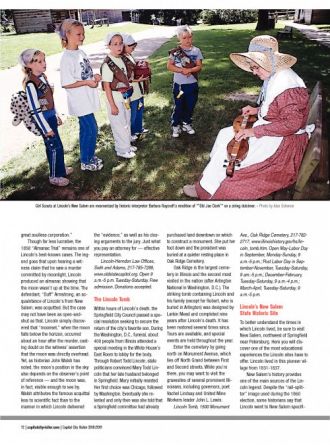
To better understand the times in which Lincoln lived, be sure to visit New Salem, northwest of Springfield near Petersburg. Here you will discover one of the most educational experiences the Lincoln sites have to offer. Lincoln lived in this pioneer village from 1831-1837.
New Salem’s history provides one of the main sources of the Lincoln legend. Despite the “rail-splitter” image used during the 1860 election, some historians say that Lincoln went to New Salem specifi-